
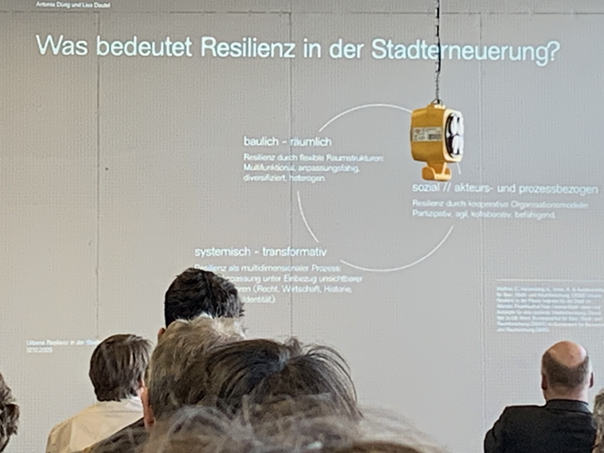
As part of the specialist conference ‘Urbane Resilienz in der Stadterneuerung’ at the Technical University of Berlin, the DigiTwins4PEDs research project presented key findings on the topic of ‘Socio-ecological transformation processes between spatial perception and well-being’. The conference brought together experts from academia and practice to discuss strategies for resilient and sustainable urban development.
The starting point for the presentation was the UN-Habitat understanding of urban resilience, which identifies protection, adaptation and transformation as key dimensions. In view of climate change, social inequality and resource scarcity, it is clear that resilient urban redevelopment requires more than technical solutions. The socio-ecological development of existing buildings and public spaces is crucial – in terms of neighbourhood, community and active participation.
The presentation examined the challenges of resilient urban redevelopment and how participation and shared responsibility can initiate and anchor transformation processes in the long term. The focus was on perception, awareness, acceptance and co-creation at the neighbourhood level. In particular, it analysed how hybrid participation formats – i.e. the combination of analogue and digital processes – and temporary interventions in public spaces can strengthen subjective well-being and increase acceptance of urban development measures.
In addition to DigiTwins4PEDs, two other transdisciplinary research approaches were presented: SURe21 investigates nature-based interventions in public spaces to promote the well-being of young people, while UMS researches participatory do-it-yourself formats for environmental awareness and climate literacy among children and young people.
In this context, DigiTwins4PEDs is testing hybrid participation formats with urban digital twins to support a citizen-driven energy transition at the neighbourhood level. Digital tools are specifically combined with dialogue-oriented on-site formats to make complex transformation processes understandable and enable co-creation.
The results presented show that target group-oriented participation formats – especially for children and young people and in neighbourhoods with increased social or ecological pressure for change – can make a significant contribution to strengthening urban resilience. The subjective experience of one’s own neighbourhood, for example through co-design, self-measurement or temporary interventions, proves to be a decisive factor for the acceptance and long-term effectiveness of transformation processes.
The article derives practical recommendations on how participatory and integrated processes can be structurally anchored in urban regeneration. DigiTwins4PEDs thus underlines the importance of digitally supported, yet socially embedded approaches for resilient and public welfare-oriented urban development.
Further information can be found here.